Saturday, July 16, 2011

Hand it to me! Week 7

1. What was it like using your hand as subject matter for a drawing?
It was a great exercise, I haven't done anything like this in years. My kids also got a kick out of watching dad try and draw his right hand. I was going to compare this with the ones I did back in 93 for NCCC but I must have tossed them away.

2. What media did you select - pencil or charcoal? Why?
I decided to use pencils because that is what I purchased for the value scale project.

3. How did it feel to create a drawing with your non-dominant hand?
I felt like I could have strapped a pencil to my dogs paw and she could have done a better job. I couldn't believe how useless my left hand was until this project. 

4. Compare and contrast your final drawings. Do you think they are successful studies?
I didn't do too bad using my dominant hand, I tried to keep the erasing down to a minimum. The non-dominant one was definitely a chore, even setting up how it was going to fit on the paper was a problem. I ended up starting the drawing with my left hand three different times so that it would fit. 

5. Would you consider using your non-dominant hand to create artwork in the future?
Pretty much the only thing I use that hand for is driving, tying my work boots and for some reason smoking my cigars. Other than those things I don't think I will use it for any other projects in the near future.


Friday, July 15, 2011

Week 7 Video Reviews

1. Explain why you selected each of the FOUR videos you choose from the selection listed above.

I chose to watch the Velazquez and Albrecht Durer videos because I had not heard of either of these artists and was curious what they were all about. Rembrandt and Michelangelo were two very well known artists that I knew I would enjoy watching. Michelangelo’s drawings set side by side with his sculptures/paintings was amazing. It was very interesting seeing how his mind worked while designing his pieces. It was so interesting to see an artist try to copy his hatchwork and not be able to accomplish it.

2.For each video list/discuss the key concepts you learned.

Velazquez Video
Velazquez was born in Seville in 1599 and in 1623 he was made the court painter for Phillip IV and chronicled the life of King Philip. He captured the movement, the light and air that was once there for only a moment in his works. Velazquez painted reality and painted it slowly. Many masterpieces took years for him to complete. He was a very educated painter and he spent two years studying Italian masters such as Michelangelo. Many of his works were influenced by other artist’s works and styles. Velazquez was an abstract painter who seemed to try to conform to reality. He used the feel of the landscape instead of an exact reproduction of it. His paintings seem to be void of movement, the objects and people seem to be getting ready to move. Buffoon paintings or Jester portraits of human freaks were painted capturing them in their real states, deformities and all. He gives them grace and beauty like giving gifts to a friend. Everything he painted was a reflection of his own being. Painting his friend (the sculptor) with little color, he had little interest in it. He painted few religious paintings, all were done on commission.

The Night Watch by Rembrandt
Amsterdam Civic Guardsmen are who were painted on a massive 11’x14’ canvas. It has been slashed with a knife, had acid placed on it and drenched in water. The Nights Watch is the greatest icon of the Dutch art culture. Group portraits were organized to paint those who served in the militia. Rembrandt did not follow traditional militia portraits, which typically would show all the men lined up in a row. He applied drama and let the people act and not just pose. Many of the figures were prosperous businessmen who paid Rembrandt for their portrait. His painting portrays action and movement. Because of the movement and dramatic use of light this work broke out from the other militia portraits. The group from the rear seems to follow the group in the foreground and. there are no stationary elements expressed in this painting. X-rays that were taken of this painting shows Rembrandt’s original plans and how it changed into the final work. There were figures that were added and that were not members of the company, a boy, musketeer and little girl. The girls presence seems to be magical, she is a focal point with her own light source. The rooster hanging from her belt is the symbol of the militia. In 1642 the Night Watch was finished. A shield was added 8 yrs later to give recognition to all who were portrayed. The Night Watch remained for 70 yrs until it was moved to a gallery. This painting was trimmed to fit into the gallery. This trimming lost some important meaning that the work initially had. During WWII the painting was moved 3 times to keep it safe. The painting saw more damage during peace time then it suffered during the war. A crazy school teacher carved it with a knife and the restoration was then documented on film. Restoration took 8 months to complete. In 1990 a man sprayed acid onto the painting and it had to be washed down with water to dilute the acid. The work was then restored again because the varnish was harmed.

Albrecht Durer: Image of a Master 1471-1528
His first work was completed at age13 and was apprenticed to his goldsmith father. Durer was interested in the process of aging. When he was 15 he apprenticed for a master painter. he was a craftsman and engraved many works. His bride was chosen for him when she was only 15 and who bore him no children. Durer was the first true landscape artist in Europe. He spent some time studying in Italy and painted many landscapes there. Venice influenced many of his works. He learned to create light and shadow using light brush strokes devoid of color. He searched for the secret of the perfect form. He returned to Nuremberg and was treated as a honored citizen. He was a member of the council of the city. His main income came from prints that he produced by woodcut. Many of his woodcuts portrayed religious depictions in support of Martin Luther. He was constantly learning styles which included perspective in his woodcuts and started working with copper engraving later in life.

The Drawings of Michelangelo
Many of his original drawings were destroyed by the artist himself because they show his hesitations and second thoughts. He was born in 1475 in Florence Italy. He was apprenticed to an artist at the young age of 12, named Ghirlandaio. Michelangelo denied being influenced by Ghirlandaio even though they sketched in similar styles. He did however teach himself to sculpt. His knowledge of the human form was amazing for the time, in 1501, David was carved out of marble. This was the first colossal marble sculpture to be carved in Italy since the time of antiquity. His poses took upon reality but with an abstract idealization of the human pose. His focus of artistic expression for 60 yrs was that of the male nude. In 1508 Michelangelo began the painting of the Sistine Chapel. There were many drawings that show his prep work for the ceiling panels. He was called to design the Medici family church of San Lorenzo. He did not finish the church, blank walls and unfinished sculptures were the result. In 1527, Medici were expelled from Florence, Michelangelo then stopped his work on the church. He was driven into hiding where he continued to work on personal pieces. His Christian faith was a driving force in his art. The Last Judgment commission was a great work that was done in Fresco. At this point he became aware of his own mortality. He created the crucifixion drawings which explored his feelings of hope and dread. Christ’s body is an example of what the male body would represent when returning to god.

2. How do the videos relate to the readings in the text?

The videos seem to relate very well with the text. Michelangelo's drawings, Durer's religious background with Martin Luther, Rembrandt's Night Watch and Velazquez being influenced by Italy are all concepts that were related in the text.

3. What is your opinion of the films? How do they add depth to understanding of the readings and art concepts?
I really enjoyed all the videos except for the one about Velazquez. This video seemed to just carry on forever and was very boring. The other three lent to the concept seeing is believing. Seeing the Nights Watch hung in the gallery really gave it some size comparison, it is such a huge painting. Seeing Michelangelo's drawings flipping back and fourth with his works was very interesting. I loved seeing how his sketches changed before the final work was completed. Looking at woodcuts that were done by Durer in his early years and comparing them to his masterpieces that he completed later in life was very interesting. Its nice to take anything that you read about and have a few videos to compare it to.The videos just seem to bring the concepts all together nicely.

Friday, July 8, 2011

Video Reviews


More Human Than Human

Images dominate our lives, tell us how to behave, feel and think, mold and define us. The human form is not depicted but exaggerated. V. Ramachandran from was also in an earlier video that we reviewed.  He tried to explain why the Venus figures are what they are. Our brains are rpre programmed to exaggerate what matters most. Large breasts, swollen hips and big bellies were traits that were looked for. Egyptian art shows each part of the human body from its clearest angle. Egyptian artist were driven by consistency and order. The reliefs were all made using a grid system. Their culture reflected their art. Culture is King driven by the types of society and its values. Ancient Greece Bronze statues were found by a diver. They were examples of the better you looked the closer to being a god you were. Belief that gods took human form is something the Greeks took from the Egyptians. They were also the first to produce realist art. Polycleitus created a series of theoretical rods that divided the body into quarters. One side of the body was depicted in motion and the other was at rest. The Riache Bronzes found on the sea floor were inspired by Polyclitus. These are so lifelike but could not be totally realist and are exaggerated. The legs are longer then they could possibly be, muscles were conveyed in the wrong position and areas exaggerated beyond human form. Humans do not like reality. We exaggerated features in art and in ourselves. This all began 30k years ago and continues into today. Just looking at our media, sports players, models, art, it is all exaggerated to express what is pleasing to our eyes.  
The reading in chapter 14 depicts the same ideas about the Greeks; they exaggerated everything, from their sculptures on up to their architecture. The Greeks made art not only realistic but much exaggerated to what was pleasing to their eyes.

Cataclysm: The Black Death Visits Tuscany

The dawn of the Renaissance was during the 1300s when Sienna and Florence were at their height. Cathedrals, buildings, palaces, square wre all being built at that time. Sculpture and paintings were also created. This was the richest time for these two areas. Peace between the cities had been achieved. Walls were erected for defense. Walls were first constructed and then the buildings were erected afterwards. The bubonic plague came over from China during 1348. One third to one half of the population in Europe died. After the plague pretty much all building had ceased in Sienna. The banks collapsed in Florence because the English King defaulted on the loans that he was given. If a king couldn’t pay back his debt then there wasn’t much anyone could do about it. Florence’s still flourished but was never the same as before the plague. Sienna had lost half of its population. It was though that the way we live our lives on earth predetermines a judgment of glory or condemnation. Proper burials were very important. Funerals were shortened during the plague years for fear of spreading the disease and not having enough time to bury so many people. Jews were persecuted and blamed for the plague. Jews were thought that they drank from wells to avoid city water, thinking that they were poisoning Christians. In some towns, Jews were butchered and burnt. Cities feared outsiders aft er the plague. Flagellation fraternities were formed. These people would hurt themselves (whip themselves) which was thought to keep them from being victims. Thinking the plague was gods judgment of the immoral, some of these beating lasted 33.5 days because Jesus was here on earth for 33.5 yrs. The plague turned social order upside down. Whole families wer destroyed. In 1348, most of the great artists were lost and artistic activity had changed after the plague. The doubting Thomas was reflected in many works of art, doubting the church. Heaven and Hell was depicted in Christian Mosaics. Figures emerged flatter than the previous centuries. Art was less realistic then artist such as Giotto. Painting was the greatest medium. Giotto depicted figures with human emotions that tell their stories. His was a medieval artist who began the early Renaissance. Real space, real bodies, real emotions and three dimensional spaces were all depicted in his works. IN the 1400s, artists created mathematical perception by using the vanishing point. Modern art restores use Renaissance tools to repaint great works of art. The crafts are still alive, making belts, wallets; key holders were accomplished using the same tools as in the Renaissance. The years 1200-1350 saw a rise of the modern city, banking and universities. It also saw a large impact of art and literature. After the plague years there was a new development in arts, philosophy and art. It was driven by a new way of thinking about us. Naturalism was now the goal of painters that led to the Renaissance.

Cairo Museum

The museum houses the most extraordinary object on earth. Visitors come from all over the world to view over 160 000 artifacts but only half of these objects are actually displayed. Most of these artifacts are housed in the basement and arrived there over 100 yrs. ago. These artifacts some of which have not been opened since their discovery, makes me think of Indiana Jones. The museum opened in 1902 and has yet to display all of its treasures.  In 1875 a man lost one of his goats near Luxor, he found his goat near the Valley of the Kings. This man also found a secret place full of treasures that he sold off for years until he was caught and forced to take authorities to his hidden place.  The authorities ended up finding 40 mummies in this hidden cache. These mummies were transported to the Cairo Museum. There is a bicentennial celebration that will be opened in new areas in the museums basement. The statue of the priest Kai which is in our textbook will be displayed at the celebration for the first time ever. This statue could be the finest piece that has ever been discovered. Not only does the museum itself house treasures that have never benen seen but there are countless storerooms around Cairo that are being examined for the best pieces for the museums bicentennial. Many of the objects have been hidden away for decades and have to be preserved before going on display. The discovery of the queen’s tomb in 1925 demonstrates how carefully George Riesner preserved the site. The Queens Throne is the only remaining artifact that has not been recreated since the tombs discovery. The discovery of King Tuts tomb is still one of the most renowned attractions of the museum. The artifacts of ancient Egypt have to be the most influential in the art world. Every piece that was discovered from the mummy sarcophagus, sculptures to reliefs are a work of art that is breathtaking.

I picked these videos because I love learning about ancient history. Anything Egyptian that I can watch or read about would be my favorite. I felt that the Greek and Roman era has a similar draw to me. Not only do I love the history but the art itself is simply amazing, there is nothing like it in the world and probably will not be anything created that will come close to their equal. I hope that someday I can take a trip to the Cairo so that I can view these artifacts up close and personal.

The readings in the text go more in depth with the concepts that are discussed in the videos but there is just something about the videos that bring everything all together. I guess seeing is believing and being able to view some of the objects that we read about is a wonderful way to learn.

Tuesday, July 5, 2011

Reviewing Classmate Blogs

James Donnelly, Project #1

   I agreed with all of James image assessments. The rug he used to convey color could also have been used for texture, line and pattern. I love the shadow that bisects this photo, it just seems to add some needed contrast. The patio block that he used for pattern could have also been used to convey rhythm, repetition and form. The stones that he used for line could easily have depicted movement. It reminds me of the outside installation that was in our textbook but for some reason I can't seem to find at this moment. Here is a favorite installation of mine: A Clothespin in Belgium I don't think there was any one item that only had a single element and principal associated with it. I think if someone looked hard enough everything has at least two from the list.

James Donnely, Project#2

   I loved  "The voyage of Life" also. Even though I am not overly religious I do enjoy the art and history that follows religion. These painting depicting a hero's journey down the river of life from childhood to youth then manhood and finally old age, would have been one of my picks as well.
   I agree that the "Coffin Bottom" is a very interesting piece. I love Egyptian art and finding out more about the man buried in that coffin interest me also. This piece must have been early just by looking at the way the person was depicted, the legs and head in a profile view but the torso and eye are frontal views.
   I felt a connection with "The First Railroad Train on the Mohawk and Hudson Road". My son loves everything about the railroad. We have taken a few trips on the rails together and love taking rind on a CSX train that a friend Engineers on.

   I didn’t have any of the same images that James had.


   I love reading about his Blogs, its good to see how other people perceive art differently and sometimes similar to what my perceptions are. James and I have similiar interests when it comes to the Egyptian world, the history and their artwork. I could look at Egyptian art all day long and never get bored of it.

Emily Krolewicz Project #1

   I think Emily did a great job on this project, all of her photos were very interesting. The slide that portrayed movement could also have been used for space, color and form. The scratches moving along the slide remind me of children sliding down one after another. The photo that was used for variety could have also depicted, color, repetition and proportion. This had an Andy Warhol feel to it, its nice to see photographs jazzed up with a little creativity. The beautiful ceiling that was taken to represent space could easily have also been used for texture, form, repetition or rhythm. Staring at the ceiling has never been so interesting, there is so much detail that it draws you right up close. Pretty much all of her photos could have had multiple elements and principals associated with them. 

Emily Krolewicz Project #2

   The ceramics piece that Emily picked by John Tracey was truly amazing. I love ceramics too and everything about the water. The coral adds so much depth to the piece that your eye is just drawn down into it and trying to absorb every little detail. I can't even imagine how much work this must have taken to produce something so beautiful. I love how it is one color so as not to detract from the detail presented.
   The "Cavatappi dei Saracino"is one of my favorite pieces that Emily had chosen. I am an Engineering Major and seem to always be drawn to anything that is mechanical. Even though this is a static piece there just seems to be something about it that conveys movement. At first glance it resembles something futuristic that could come alive at any moment. The form, space and great detail is so creative and interesting. I would love to have this piece sitting in my dining room.
 
   Emily and I didn't have any of the same images.

    I really enjoyed reading the Blogs that Emily published. This is a great learning tool in that it gets me thinking about different pieces and gives more examples of what differentiates one piece from another. Reading others Blogs opens me up to interpretation that I may have never realized by myself.

I don't have any comments left on any of my Blogs as of yet but I am anxiously awaiting some creative criticism. Comments are always welcome, it is how we learn.

Sunday, July 3, 2011

Installation Attempt

Installation art is usually created inside or out. This type of art is meant to be viewed usually in the round and isn’t restricted to just a canvas or table top. Installations interact with the viewers as they move around or even through the art. Installations can be made of anything you can think of, from flowers, car tires, sculptures, sounds, videos or even car tires.  The environment or space that the installation occupies usually drives the installation or has something in common with it. This type of art can either be temporary or permanent.
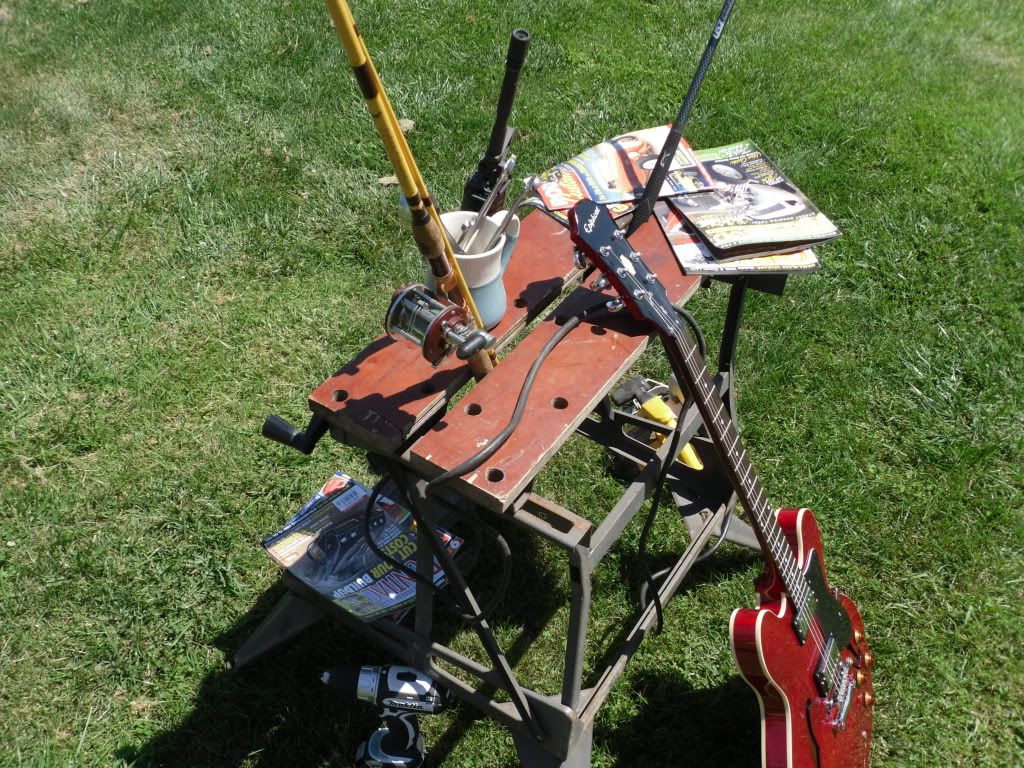
I pretty much understand what installation art is but I never thought of myself as artsy so actually creating an installation was somewhat of a challenge. I had set up 3 other attempts at installation. One attempt was my lawn tractor pulling the kids bicycles with a chain and my dog driving but I had a hard time keeping it all together (dog wouldn’t cooperate).  I decided to take my hobbies and create something that defines my personality. The objects that I used were, my Epiphone Dot Guitar, AR-15 rifle, cordless drill, circular saw, my golf club, fishing pole, car magazines, wrenches , workbench and my #1 Dad coffee mug. I decided to set up outside in the grass because that is where I like to spend most of my days. I'm not sure if this would have worked so well just setting it up inside the house, bringing the items outside add to the feeling of being free and able to enjoy many of my hobbies.  If I had to name this piece I would call it Boys and their Toys.
The installation is pretty well balanced even though my eye is drawn to the coffee mug. I’m not sure if the coffee mug is drawing me because the color contrasts the darker items or that it has more of a personal feeling for me.  The rifle and guitar on separate sides of the table almost feel as though they are opposites but balanced, like yin and yang. The objects are all things that I enjoy doing but the mug represents who I really am, after all the “things” that make up my hobbies are gone. The most important part of my life is being a father and mentor to my children. 
     Wind played a small factor in that the magazines were blowing everywhere but I didn't want to place anything on them. This makes a strong argument that the environment that an installation is set up in plays a unique roll. 

Friday, July 1, 2011

Frank Lloyd Wright. Prairie Style


1. For each video list/discuss the key concepts you learned.

The Prairie Styles was made famous by Frank Lloyd Wright.  His houses were single family dwellings that were wide open, horizontal living spaces that were meant to blend into their natural surroundings.  There weren’t rooms divided normally as in Victorian homes but the rooms were left open so that they flowed into one another. The ceiling levels in these houses were brought down to force the observer to look horizontally about the space. These houses were set to follow the sun, as the sun moved about the sky the light would light up the house as though it was following the sunset. The fireplaces were meant to symbolize the heart of the house that is why they were set in the center of the home. Furniture in some of these homes were built in and found throughout the space. The sites itself is one of the most important parts of this style. The surroundings and the house must coincide with one another.  The prairie design was meant to look as though the house grew out of the site and was not just built there. Wrights architecture was organic, the inside and outside of the homes were integrated.  

2. How do the videos relate to the readings in the text?

The video helps to relate the readings to actual examples of Prairie style homes. It is hard to know what Wright meant when his works were thought of as organic without seeing examples.  His homes are beautiful and from seeing a few of them I now understand how they are seen as organic in nature. These homes really did look as though they were always part of the site.

3. What is your opinion of the films? How do they add depth to understanding of Architecture?

I enjoyed the FLW film and would love to see one of his houses in person. Architecture is a very diverse and complicated concept but the video did give me more of an understanding of what is meant by Prairie Style. I had no idea what this was and that Frank Lloyd Wright was the inventor of this type of architecture.  This video was one of the more interesting in the series.

4. From the group of four that you had a choice: Why did you choose that film?

I probably chose this film because of the Frank Lloyd Wright homes and buildings that are found throughout WNY. From what I have seen of a few of his homes I was really impressed how inviting they were and how they seem timeless. Reading up on FLW and watching the video really gave me more of an understanding of the Prairie style and I will visit one of his homes in the near future.

Sculpture, Ceramics and Installations oh my!

1. For each video list/discuss the key concepts you learned.

     Sculptures are seen as already being inside the block of marble and all the artist has to do is remove it. The artist checks the stone with a hammer to hear the harmonics which checks the block for cracks or inclusions. Sculptures are usually made from clay, bronze, limestone or marble. The environment that the work will live in plays an important part in what type of work the artist makes. A statue that will stay outside all the time will have to be made from a hardier piece of marble then one that will stay indoors. After a work is completed, it made need to be moved so the artist leaves bridges of marble between fragile areas and finishes removing them after the work has made it to its final destination.  Most artists will first draw his work, and then sculpt it from clay; this will then be molded from silicone and cast in plaster. The plaster casting will then be used by the final artist to copy and make the sculpture. Most sculptures are created by teams that each has a job. One artist was used to sculpt in clay, one to cast and a final to carve it out of marble. During the final sculpting of a work a point machine is used by an artist to copy the casting perfectly onto the marble. From the time an artists dreams up an idea for a sculpture it can take years until the artist is done creating his work. 
     Glass is made mainly from silica sand that is mixed with fluxes that contain soda, pot ash, oyster shells or limestone. This flux prevents the glass from becoming too fluid at high temps. This is called Fusion. The glass is heated to a molten state and then a glass blower molds the glass with steel or even his hands using a wet newspaper. The air hardens the glass and the artist has to keep it malleable by heating it again. After the last shape is achieved the glass is fired one last time to make sure that it will withstand changes in temperature, without this step glass would be so fragile that just running it under cold water could break it. Colored glass used in stained glass is originally clear but is chemically bonded to the pigment which makes it permanent but still  remains clear. A model of the glass window is made and then traced to scale and the pieces numbered.  Each piece of glass is cut out and assembled like a jigsaw puzzle. Lead strips are used to hold the glass pieces together and fastened to each other by soldering them.  Ceramics are made using a mix of clay and quartz ground down and mixed with water. This makes a slick that is packed in cylinders. The cylinders are mixed again with water and poured into molds; the pieces are dried a bit and removed from the mold. These pieces are then fully hardened, then fired in a kiln which gives them their strength. A glaze is then applied, either dipped, sprayed or hand painted. These glazes can be either clear or colored depending on the piece. The work is then fired in a kiln one last time to create the finished piece. Glass can be used for windows also; they can reflect heat during the day and cool at night. Glass can be used for protection and also for noise reduction.
     Installation art can take over an entire space internally or externally. Most installations are not usually meant to be moved or sold. The locations tend to lead to site specific art; the space that it will take over sometimes helps define the installation. Land art is a good example of this, they usually only can exist in one location. This art is meant to be viewed in three dimensions. The viewer is drawn into the artist’s world and forced to interact with the art. Installation art can contain music, video, painting, performance, architecture and painting, what ever the artist dreams is never-ending. The museum usually has to give up a large space and give it to the artist completely, letting him call all the shots.

2. How do the videos relate to the readings in the text?

     The videos relate pretty well to the readings. It is always easier to understand concepts by seeing examples for yourself with your own eyes. It is very hard to read about concepts like these without seeing examples on video. Even though the videos are generalized, the text seems to bring all the concepts together.  Installation art has to be one of the most diverse forms of art that I have ever witnessed. The different concepts and material used to complete an installation is never ending. This type of art may not even be permanent and is usually destroyed shortly after it is created.

3. What is your opinion of the films? How do they add depth to understanding of the topics: Sculpture, Installation, and Craft?

     I really like the sculpture and installation films. I had no idea the process that was behind creating a sculpture. I thought that one artist just started carving a piece from start to finish; I had no idea that there was a team involved and steps in that process. Seeing the sculpture move from start to finish was amazing, to think that a stone that was so hard could be carved to actually look lifelike and to resemble skin. It was cool to see the man that was roughing out the sculpture, he was like a sub-contractor. I would assume other types of artists use people like him in different art processes from sculpture to painting. Installation art is very interesting, it really seems like there are no limits especially when dealing with outside spaces. I loved the cows that were cut in half; it was cool to see all the different examples of installation art portrayed in the video. I could open the door to my messy garage and call it installation art. The fact that the artists want the viewer to participate in the art and almost forced to participate in the artists concept. The ceramics/glass video was pretty boring and other than the stained glass and blower was not very interesting. The only thing I got out of that video was a need to go to the Museum of Glass in Corning and watch some glass blowing up close and personal.